


Business Case
66% of gender diverse employees won’t even apply for a job in a company “where they perceive the culture to be noninclusive.” Dupreelle, Schachtner et al, 2023
The workforce is increasingly gender-diverse. Yet, two-thirds feel like they don’t belong. (Harvard Business Review, 2023)
By 2030, Gen Z will comprise 35% of the workforce, including approximately 6 million transgender and nonbinary employees. Today, two-thirds of the gender-diverse workforce feels unsupported. Businesses that don’t invest in workplace policies, processes, and culture improvements will lose talent, productivity, and competitive advantage. (References)
Today’s Reality
A significant pay gap between gender diverse workers and their peers, indicating systemic workplace inequities.
Gender diverse talent actively avoids companies and entire industries they perceive as unsafe or non-inclusive, leading to a loss of potential workforce.
Despite widespread public support for equal rights, workplace discrimination against transgender employees remains commonplace, showing a disconnect between societal values and workplace realities.
Major corporations have widely adopted gender identity protections, establishing inclusive policies as a business standard rather than an exception.
Allies are watching and making choices accordingly. 73% of Americans believe workers should be treated fairly regardless of gender identity, and younger employees—who will comprise the majority of the workforce by 2030—actively choose employers based on inclusive values and practice.
Direct Business Impact
Opportunity Costs:
Limited talent pool
Loss of qualified candidates
Competitive disadvantage for top talent
Operational Costs:
Higher turnover and recruitment costs
Lost productivity and reduced employee engagement
Reduced innovation and collaboration
Strategic Risks:
Reputation damage
Risk falling behind industry standards
Potential market share loss
Legal risks and liability exposure
-
“Belonging is not abstract—it is operational. When employees are supported in their gender identity, organizations see stronger engagement, retention, and long-term performance.”
— RaShawn Hawkins (she, her), SHRM-SCP
Senior Director, Workplace Equality Program
Human Rights Campaign
What is the gender spectrum?
The gender spectrum acknowledges that there's a range of gender identities between and outside of the binary categories of male and female. Within this spectrum, there are multitudes of gender identities.
What is gender identity? Isn't it the same as a person’s sex?
Gender identity is not the same as a person’s sex and is separate from it. Gender identity is an individual’s innate deeply held gender truth from heart, mind, and soul. Everyone has one.
The data is clear: workplaces aren't working for gender-diverse employees
9% did “not feel the gender they express at work matches their true gender identity.”
67% of gender diverse people felt extremely uncomfortable in their job settings, and as such "reported negative outcomes such as being fired or forced to resign, not being hired, or being denied a promotion".
“13% [of respondents] felt exhausted from spending time hiding their gender identity.”
Gender diverse employees often feel alienated and under-represented, and 2x “more likely” than their peers to feel as if there’s no one else like them in the room.
“30% of transgender employees have been fired, denied a promotion, or experienced another form of workplace mistreatment due to their gender identity or expression.” (Human Rights Campaign, 2018)
Trans people “earn 32% less” than their peers.
“43.3% of transgender employees reported experiencing verbal harassment at work compared to 29.3% of cisgender LGB employees.”
“59%” of transgender people do not “pursue certain industries” due to fear of safety.
Understanding workplace belonging through the lens of gender identity isn’t a culture trend.
It is a business imperative.
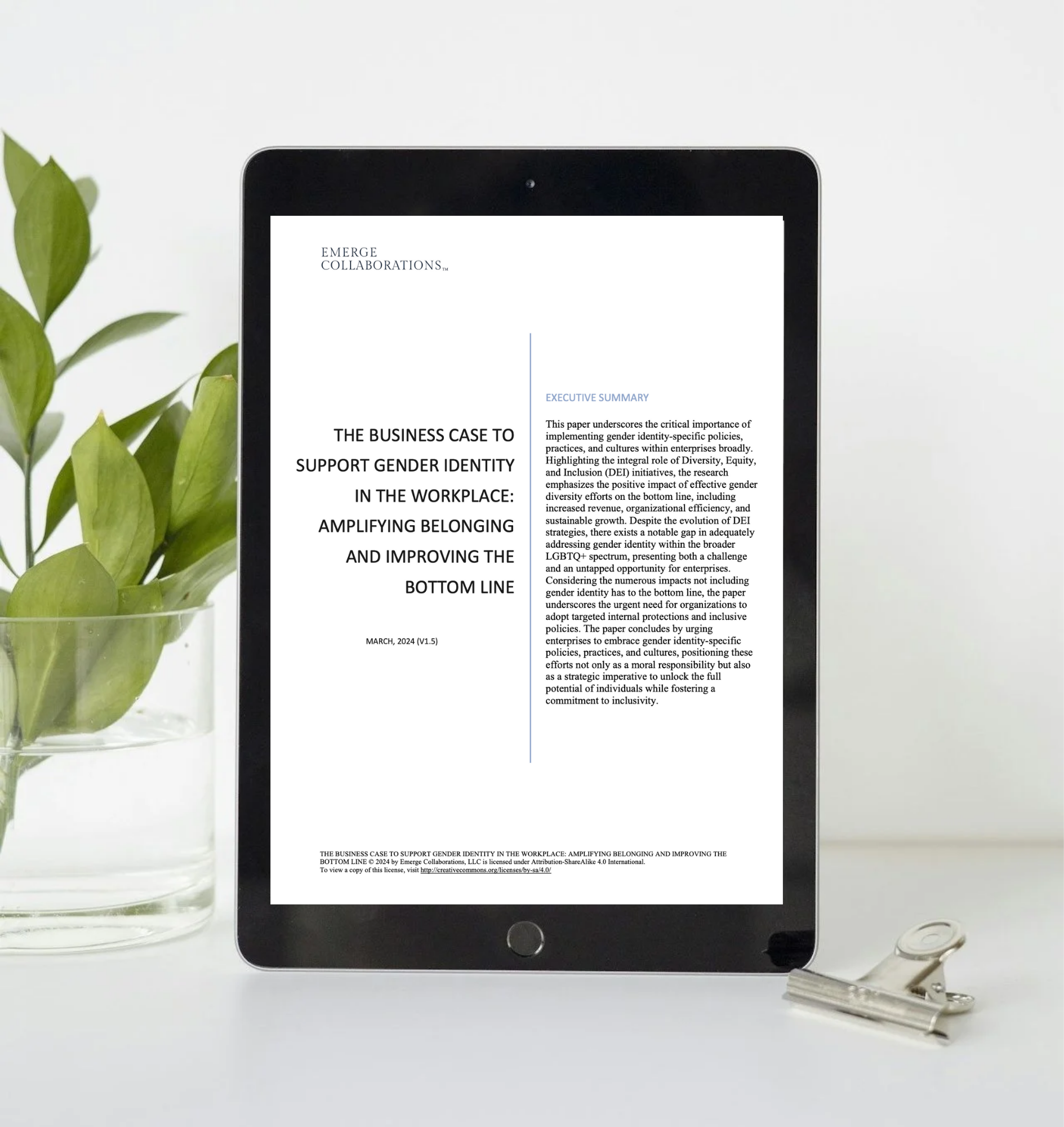
The Business Case to Support Gender Identity in the Workplace
Amplifying Belonging and Improving the Bottom Line
This research demonstrates how gender diversity initiatives drive measurable business outcomes: increased revenue, organizational efficiency, and sustainable growth.
Despite widespread Belonging efforts, a significant gap remains in addressing gender identity within the broader LGBTQ+ spectrum—presenting both a challenge and an untapped opportunity. This paper provides the business case for Fortune 500 companies to adopt targeted, gender identity-specific policies and practices.
“Three comprehensive studies agree that successful Belonging initiatives boost revenue and positively impact various aspects within an organization, including: improved performance, talent retention, enhanced decision-making, customer insight, innovation, motivation, teamwork, productivity, reputation, and financial capacity.”
More Resources
Access practical resources to deepen understanding of gender identity and belonging.
Navigate common questions about our services, approach, and working with us.
Build foundational knowledge of gender, sex, and identity terminology.
Explore gender identity through personal narrative and authentic storytelling.




Advance gender equity and belonging in your enterprise.
Equip your leaders and teams with deeper understanding of gender identity to foster authentic belonging in the workplace.
Strengthen workplace belonging across your policies, processes, and culture.